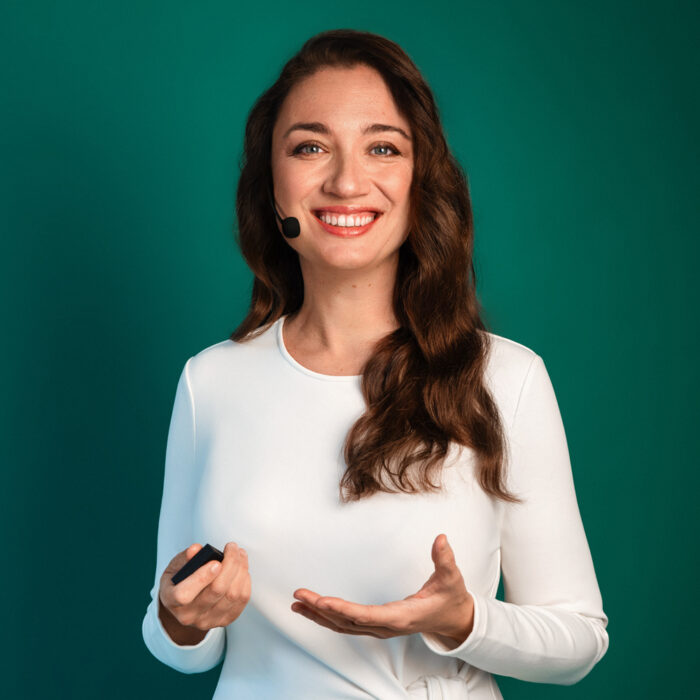
Dr Anastasia Dedyukhina is an internationally acclaimed thought leader, author and speaker (twice TEDx) on the topics of digital wellbeing and mental health in the digital age. Her message goes far beyond reducing the screen time. Anastasia explores, how technology usage affects our ability to stay focused, build trust online, and the risks of outsourcing our cognitive and physical abilities to tech. Emphasizing the need to enhance human qualities, she advocates understanding how technology can support, not hinder, our wellbeing in the AI age.
We are delighted that Anastasia will be joining us in Madrid next week where she will be showing us how we can Prevent Digital Burnout as well as chairing out DEI Leadership Panel.
We caught up with her to see how she’s feeling in the run up to the summit:
Hi Anastasia we are thrilled that you are joining us at the Wellbeing at Work Summit in Madrid next week. Our first and most important question is, how are you doing today?
Thanks for asking 😊 I’m great, full of ideas and can’t wait to share them!
As a leader based in the region, what are the main challenges you are facing when it comes to employee wellbeing and mental health?
People are digitally overloaded and stressed, mental health problems are on the rise. Technology is the elephant in the room and nobody is talking about it seriously in the context of work. Being “always on”, constantly switching tasks, sitting long hours in front of the screens, trying to catch up with never-ending information, not having enough in-person interactions is damaging for mental and physical health and wellbeing. Tech allows us to do amazing things, but it also puts a heavy tax on our health – I call it a Tech Tax.
After the covid, for a certain period it seemed that organizations did get seriously concerned about how tech overuse is impacting employee’s wellbeing – but with the arrival of AI it suddenly has become less of a priority. This is a very big mistake – you cannot successfully deploy AI when people are stressed, tired and resentful – the adoption rates will fall drastically, and AI adds another layer of complexities to team dynamics.
What strategies have you seen developing over the past 6 months, both internally and externally, that are moving the dial on wellbeing in the workplace?
We at Consciously Digital Institute (www.consciously-digital.com) help prepare internal digital wellbeing champions (similar to what Mental Health First Aid does). These are people who understand the impact of digital tech and can lead initiatives and conversations about healthier ways to use tech at work.
Why is employee wellbeing so important to you personally?
Before starting CDI 10 years ago, I worked for many years in the tech industry, and I saw myself things that I do not want to see anywhere. I saw people sitting in the same room and talking to each other via a chat, not in person. I saw healthy young people having nervous breakdowns in the office from digital burnouts, because they couldn’t be “always on” anymore. Tech industry is often described as a dream destination, but the truth is that it has one of the highest burnout rates, and people who have worked in it know this first hand. Lots of our clients come from tech companies.
What impact is AI having in your organization and how are you managing that?
We closely study AI and read all reports related to how it affects workplace wellbeing – lots of interesting findings there to share. Probably, the most important one is that AI affects different people differently – and it looks like we are heading to a big digital divide, rather than equality of everyone.
On the team level, we do not deny it, but allow use for certain tasks and do not allow for others – for example, I never use AI to do my writing (but may use for proofreading since I am not a native English speaker).
Other than AI, are there any challenges that you are seeing for the first time and how are you addressing them?
These are AI-related – people stop communicating directly. They more and more use intermediaries (AI) to script difficult conversations, to talk to colleagues and clients. For me it’s concerning on so many levels, because ability to communicate is directly related to ability to process your thoughts, and express your feelings. If we are losing it – we are losing a big part of what makes us human.
What areas do you think employers should be focused on over the next 12 months?
You are balancing two very difficult areas. On one hand, you need to explore and adopt new technology that is evolving super rapidly. On the other hand, you need people to be capable to do it – and people who are overwhelmed, reactive and burnt out cannot do it. They cannot be innovative and creative, their nervous system and brain is in a different state. So my advice is to focus on helping employees slow down to speed up – taking care of their routines, attention, learning to focus on core things, training attention, communication skills and critical thinking – all skills relevant in the future of work, and then giving them enough flexibility to explore AI tools and regularly exchange feedback.
Do you feel that investment in employee wellbeing in the region is increasing or decreasing and is that a direct reflection on HR leaders’ increasing ability to demonstrate effective returns of their strategies to leadership?
We operate globally, I’d say the investment in wellbeing did not quite decrease, but has shifted to AI-driven solutions, and while it may have some benefits, it is not a universal solution. Because ultimately, it’s the company culture, the trust, the clarity of responsibilities that creates the culture that supports wellbeing. It’s a mindful usage of technology, it’s respect towards others’ attention. You cannot outsource this to technology or to any external consultant, this has to be done by people inside your company.
How has your organisation been leading the way?
We are big believers that a healthy digital culture is created by people, not by tech – this is why we prepare digital wellbeing champions for workplaces.
Anastasia is speaking in Madrid as part of our Wellbeing at Work Summit Europe 2026 which takes place in Zurich, Amsterdam and Madrid this month. Click the links below to find out more and book your tickets: