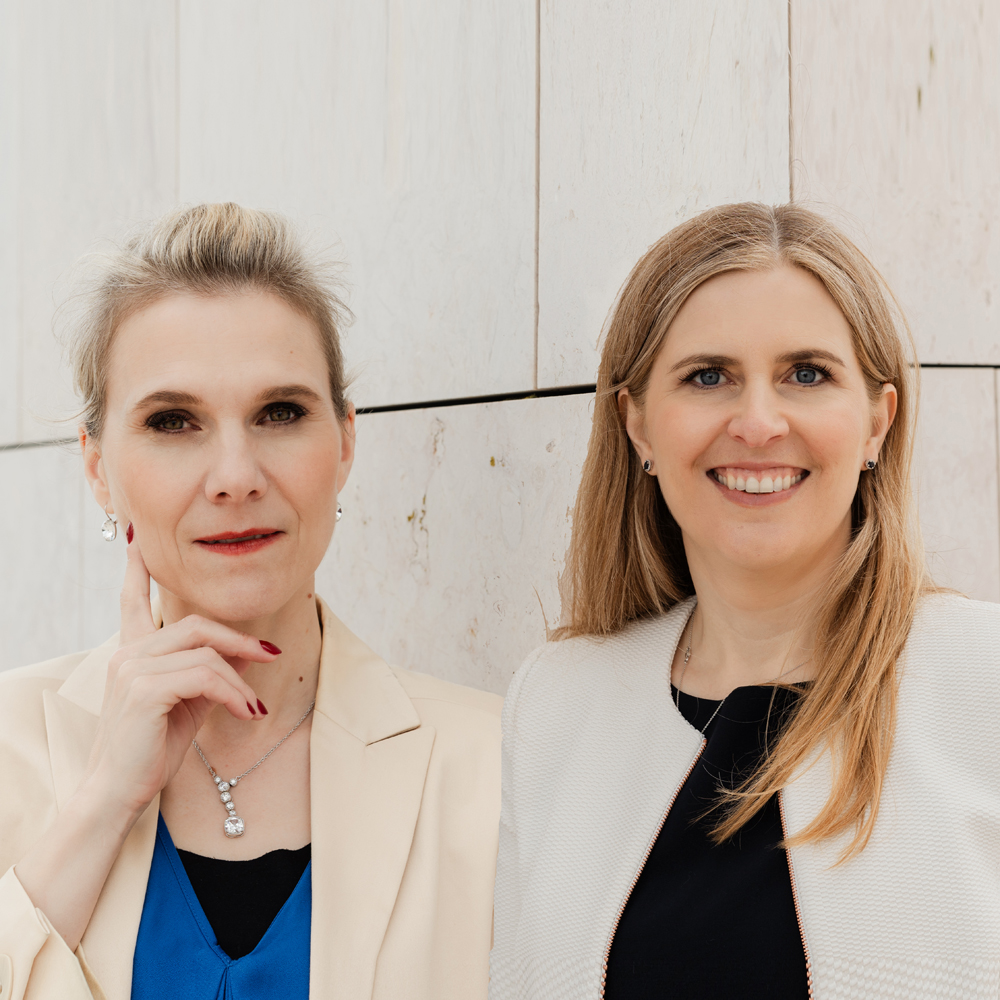
Dr Sophie Jablonski is a Life Coach and Positive and Financial Psychology Practitioner specialising in emotional intelligence, leadership, and financial wellbeing. She is the Founder and CEO of Dr Sophie Coaching and Co-Founder of Flourish Financially, through which she has supported over 100 clients since 2023 using evidence-based positive psychology and a deeply human-centred approach to financial empowerment and flourishing.
Minna Schmidt is a Financial Wellbeing Coach and Certified Financial Advisor (IAF) in Switzerland, specialising in holistic financial planning, investing, and financial empowerment for individuals and organisations. She is a Co-Founder of Flourish Financially, a platform that combines financial education with positive psychology to help people and professionals in organisations build confidence, resilience, and lasting financial freedom.
We are delighted to be partnering with Flourish Financially for our Wellbeing at Work Summit in Zurich this week where Minna and Sophie will be running a workship entitiled “Beyond Pay and Pensions: Turning Financial Stress into Workplace Resilience”.
We caught up with them to see how they’re feeling in the run up to the summit:
We are thrilled that you are both joining us at the Wellbeing at Work Summit in Zurich this week. Our first and most important question is, how are you doing today?
We are both doing very well, thank you. This is a particularly energising time for us, as we see growing awareness around financial wellbeing at work. There is a real shift happening, from seeing money as a purely private matter to recognising its impact on emotional wellbeing, focus, and performance. It feels meaningful to contribute to that conversation at this moment.
As leaders based in the region, what are the main challenges you and your clients are facing when it comes to employee wellbeing and mental health?
One of the key challenges we observe is that organisations are increasingly investing in wellbeing, yet often still address it in a somewhat fragmented way.
At Flourish Financially, we approach this through a more integrated lens, what we call financial health and wellbeing. This means recognising that financial experiences are not only practical or numerical, they are also emotional, psychological, and deeply connected to a person’s sense of safety, identity, and future.
What strategies have you seen developing over the past 6 months, both internally and externally, that are moving the dial on wellbeing in the workplace?
We are now seeing increasing openness to topics that were previously considered too personal, such as financial wellbeing, when approached thoughtfully. The shift is from providing information to creating spaces for reflection, awareness, and meaningful action.
In many organisations in the past, financial wellbeing has been reduced to compensation, benefits, or pension schemes. While important, this overlooks a critical dimension: how people actually feel, think, and behave in relation to money. Financial stress, for example, often remains invisible, yet it can significantly impact focus, decision-making, and overall mental load.
Our work is precisely at this intersection. By combining financial education with positive psychology, we help individuals develop self-awareness, build confidence, and take meaningful action in a way that feels grounded and sustainable.
This is also the core of the workshop we will be bringing to the Summit. The idea is to help organisations move from seeing financial wellbeing as a numbers-based topic to recognising it as a strategic dimension of employee health and performance.
Because when individuals feel more secure, more in control, and more aligned with their financial lives, they free up cognitive and emotional capacity. And that, in turn, supports better performance, stronger collaboration, and more resilient, thriving teams.
Why is employee wellbeing so important to you personally?
For both of us, this work is deeply personal. We have seen how capable, high-performing individuals can feel uncertain or even overwhelmed when it comes to certain areas of their lives, and money is often one of them.
What is increasingly clear, both from research in positive psychology and from what we observe in organisations, is that flourishing individuals consistently perform better. When people feel more secure, more confident, and more aligned, they have greater cognitive capacity, better emotional regulation, and stronger engagement. This naturally translates into higher quality work, better collaboration, and more resilient teams.
Financial wellbeing is a particularly powerful entry point into this process. Our relationship with money touches on identity, emotions, decision-making, and future orientation. When individuals develop clarity and confidence in this area, it often creates positive ripple effects across many other dimensions of wellbeing.
At Flourish Financially, when we talk about wealth, we do not just mean numbers. We mean that deeper sense of trust in oneself, the ability to make decisions with clarity, align choices with values, and feel secure about the future. And from that place, people do not just feel better, they contribute more fully, interact more constructively, and help create stronger, more thriving organisations.
What impact is AI having in your organisation and how are you managing that?
AI is already shaping how we think, create, and structure our work. We see it as a powerful support tool, particularly for exploring ideas and increasing efficiency.
At the same time, what strikes us most is that this shift is not only technological, it is deeply psychological. It asks us to develop discernment, intentionality, and self-leadership in how we engage with these tools.
In our work, which sits at the intersection of financial decision-making, emotions, and behaviour, depth and nuance remain essential. We are therefore very intentional in how we use AI, as a support rather than a substitute, ensuring that our work remains grounded in human insight, coaching, and evidence-based practice.
In many ways, this moment is similar to what we observe with money. It is never only about the tool. It is about the relationship we create with it.
Other than AI, are there any challenges that you are seeing for the first time and how are you addressing them?
One of the emerging challenges we see is not a lack of information, but a lack of clarity and inner alignment. People are navigating increasingly complex environments, whether in relation to work, life transitions, or finances, and this can create a sense of fragmentation.
In the financial space in particular, there is more content, more advice, more noise than ever, yet many individuals still feel uncertain, hesitant, or disconnected from their own decision-making.
Our response is to bring the focus back to the human level. At Flourish Financially, our mission is to help people build that inner sense of “I’ve got this” — the calm confidence to trust themselves, their choices, and their future.
We do this by combining financial education with the science of positive psychology, helping individuals reconnect with their values, develop self-awareness, and take meaningful, grounded action. In a world that is accelerating, the ability to stay aligned with oneself becomes a key capability.
What areas do you think employers should be focused on over the next 12 months?
We believe employers should focus on recognising financial wellbeing as a core component of overall wellbeing and performance.
This includes:
- acknowledging its impact on focus and engagement,
- creating safe and appropriate ways to address it,
- and equipping employees with both the knowledge and the psychological tools to take action.
Importantly, this can be done without crossing personal boundaries, when approached with the right framework.
Do you feel that investment in employee wellbeing in the region is increasing or decreasing and is that a direct reflection on HR leaders’ increasing ability to demonstrate effective returns of their strategies to leadership?
We see continued investment in wellbeing, but also increasing scrutiny around impact. Organisations are asking more clearly: what actually works?
This is a positive development. It encourages a move towards more evidence-based, targeted initiatives that address root causes, rather than surface symptoms.
How has your organisation been leading the way?
One of the ways we are leading is by moving beyond awareness into genuine action. We have found that many wellbeing initiatives do well at opening conversations, but leave people uncertain about what to do next. Our focus has been on closing that gap.
We have developed programmes that combine hands-on, step-by-step practical work with deep mindset and behavioural insight. Two examples we are particularly proud of are our Financial Health Check — a structured programme that helps individuals build a clear, honest picture of where they stand financially and emotionally — and our Start Investing programme, which guides participants through the concrete steps of building an investment portfolio for the first time.
What makes these different is that they do not separate the numbers from the human experience. Participants work with real figures, make real decisions, and at the same time explore the beliefs, fears, and patterns that have shaped their relationship with money. That combination — rigorous and practical on one side, reflective and psychological on the other — is where lasting change happens.
We bring this same approach into our corporate work. When we work with organisations, we are not delivering generic financial literacy content. We are creating structured experiences that help employees develop both the knowledge and the inner confidence to act — and to keep acting, even when markets are uncertain or life gets complicated.
This is what we mean when we talk about financial wellbeing as a strategic capability. It is not a one-off workshop. It is a shift in how people relate to their financial lives — and that has real, measurable effects on focus, resilience, and performance at work.
Minna and Sophie will be speaking in Zurich this week as part of our Wellbeing at Work Summit Europe 2026 which takes place in Zurich, Amsterdam and Madrid this month. Click the links below to find out more and book your tickets: