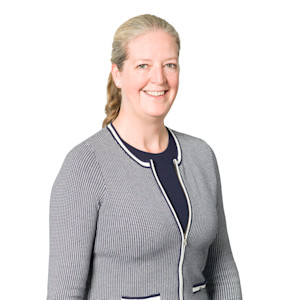
As Chief People and ESG Officer, Lucy is responsible for leading our People and Communications teams and driving our Environment, Social and Governance (ESG) initiatives. Lucy joined Computershare in 2005 as Marketing Director for the EMEA region, was part of our first sustainability committee in 2006, became Corporate Communications Director in 2010, and was appointed Head of People in 2019. She has more than twenty-five years’ experience in communications, marketing and corporate engagement roles across global companies, including time spent living and working in Hong Kong.
We are delighted that Lucy will be speaking in Hong Kong as part of our Wellbeing at Work Summit Asia this April. We caught up with her to see how she’s feeling in the runup to the event.
Hi Lucy we are thrilled that you will be joining us at the Wellbeing at Work Summit Asia in April. Our first and most important question is, how are you doing today?
Interesting question. I’m feeling nervous that the people who lead various countries around the world have plunged millions of people into a state of war which is certainly not good for the overall well-being statistics of the human race or our planet. I’m certain this will be affecting our employees too.
As a leader based in the region, what are the main challenges you are facing when it comes to employee wellbeing and mental health?
Locally, we’ve made good progress as an employer with people feeling they have a good work/life balance; and not feeling an obligation to demonstrate presenteeism. Employees also tell us that they want to have their own place to live rather than sharing with family or friends. Personal space is important so I’m interested in finding ways to help employees achieve those goals in the face of Hong Kong’s challenging property markets.
What strategies have you seen developing over the past 6 months, both internally and externally, that are moving the dial on wellbeing in the workplace?
Internally, one of the biggest initiatives for us is the introduction of our new global bonus scheme. It’s a significant change in how we recognise and reward performance across the organisation, and it’s already helping to create more clarity and motivation for our people. Externally, we’re seeing a lot of movement in the financial services industry as we experience a more active IPO market in Hong Kong. With talent becoming increasingly mobile, many companies are strengthening their compensation packages to attract and retain the people they need and equity is playing a much bigger role in that.
Together, these trends show that wellbeing isn’t just about support programs. It’s also shaped by how people are rewarded, how secure they feel, and whether they believe they have a future with their employer.
Why is employee wellbeing so important to you personally?
We run on our people – we don’t manufacture goods – our people are everything to our organisation. I’ve been here 20 years and know thousands of our people personally, so their success really matters to me. We’re the kind of organisation that supports people through the ups and downs they experience, so it’s important to me to understand what’s going on in my team’s lives.
What impact is AI having in your organisation and how are you managing that?
We see AI as an opportunity and are giving all of our people the chance to get trained on the aspects of AI that can be beneficial to their role and in turn improve outcomes for their customers.
Other than AI, are there any challenges that you are seeing for the first time and how are you addressing them?
One of the biggest new challenges I’m seeing is how varied and personal people’s needs have become. Whether it’s cost‑of‑living pressures, wanting more stability, or planning for the future, people are looking for support that genuinely helps them navigate life outside of work as well. We’re responding by offering more practical tools that build confidence, including financial wellbeing support and easy access to our own employee share plans. Giving people a simple way to build long‑term security makes a real difference.
What areas do you think employers should be focused on over the next 12 months?
I think the next year needs to be about giving people stability, clarity and a sense of progress. With so much uncertainty in the world, employees want to feel that their work has direction and that their organisation is helping them build a strong future. That means clear communication, good leadership, real development opportunities, and support for financial resilience. One thing that matters a lot to our people is having a stake in the company’s success, which is why we continue to offer employee share plans. Helping employees build confidence in their careers and in their financial future is important in helping them to thrive.
Do you feel that investment in employee wellbeing in the region is increasing or decreasing and is that a direct reflection on HR leaders’ increasing ability to demonstrate effective returns of their strategies to leadership?
I can only answer for our company and it’s definitely increasing. I think it is a reflection on how to pitch wellbeing in a commercial context.
How has your organisation been leading the way?
We’ve improved our benefits and the communication around them. In Hong Kong & China, our employee share plan ownership take-up was 63% in 2025. We’ve been doing more volunteering, more company sponsored events and were delighted to be awarded ‘Advanced Performance’ by Hong Kong’s Caring Company scheme in 2025. We have our eye on the top rating this year!
Lucy is speaking in Hong Kong as part of our Wellbeing at Work Summit Asia 2026 which takes place in Hong Kong, Singapore and Bengaluru this April. Click the links below to find out more and book your tickets:
April 23 2026 – Hong Kong. Click here to find out more and book your tickets
April 28 & 29 2026 – Singapore. Click here to find out more and book your tickets
April 20 2026 – Bengaluru. Click here to find out more and book your tickets