Post New York Summit observations from Regenerate, one of our proud US Partners.
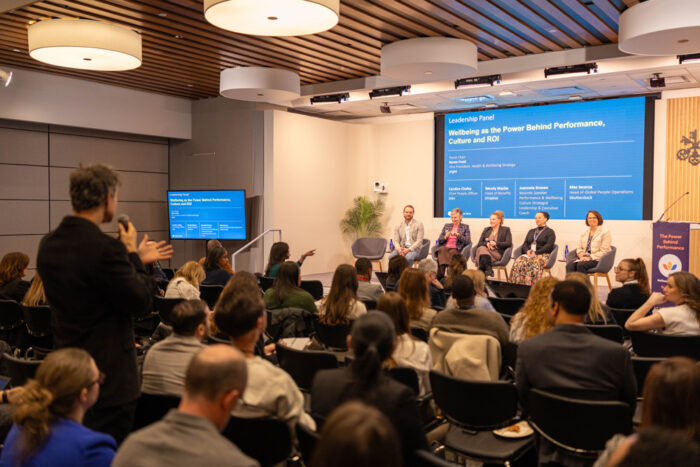
Workplace wellbeing is rapidly becoming a strategic business issue.
This past week, our Head of Strategy and I were in New York City as a sponsor at the Wellbeing at Work Summit. We spent the day listening, learning, and engaging with leaders who are deeply invested in improving how work actually works for people.
What I found most intriguing was not simply the scale of the wellbeing conversation – it was the evolution of it. For years, workplace wellbeing lived mostly at the edges of organizations. It was often treated as a benefits program, a vendor solution, or an HR initiative running alongside the “real work.”
That is changing.
Across sessions on mental health ecosystems, preventative design, wellbeing at scale, personal sustainability, and wellbeing as a leadership skill, a new idea is becoming clear:
Wellbeing is no longer a peripheral conversation.
It is increasingly being recognized as a core capability of healthy organizations.
Ironically, one group is still sometimes missing from the conversation: the very people most responsible for shaping the conditions of work – leaders.
From our perspective, four themes emerged that organizations should be paying close attention to. At the end of the article, we also share several research findings that support these observations.
1. Wellbeing Is the Engine of Performance
For too long, wellbeing has been framed primarily as recovery from stress or burnout. A deeper, more proactive conversation emerged at the Summit centered on something more fundamental: human capacity.
Wellbeing is not simply the absence of stress. It is the presence of the conditions that allow people to perform at their best.
Those conditions include:
- Feeling valued and respected
- Experiencing and building trust
- Having meaningful human connection
- Having the energy to engage fully in work
When these elements are present, performance becomes far more sustainable. When they are missing, performance is undermined. That is your connection between wellbeing and performance.
2. Wellbeing Is Not (Just) the Province of HR
One of the strongest signals across the summit was the shift away from siloed wellbeing programs. Leading organizations are recognizing that wellbeing cannot live in a single department.
It touches:
- leadership
- operations
- culture
- technology
- learning
- organizational design
When wellbeing sits exclusively inside HR or benefits teams, three things tend to happen:
- It becomes disconnected from the actual experience of work.
- Leaders see it as something adjacent to performance, rather than integral to it.
- Your people who are responsible for wellbeing efforts readily burnout (ironic, right?)
That is why more organizations are now involving senior leadership, operations, and business units directly in wellbeing strategy.
If wellbeing is central to your culture, it cannot live on the margins of your operating model. This systemic shift was visible throughout the Summit.
3. Stop Outsourcing Leadership When It Comes to Wellbeing
One of the most honest conversations at the summit centered around a simple truth:
Programs alone will not create healthy workplaces.
Platforms, apps, benefits, and training programs are valuable, but they are not sufficient. What people experience most consistently is not the platform – it is the behavior of their leaders.
Do leaders model:
- boundaries
- recovery
- sustainable performance
- flexibility and trust
Or do they unintentionally model the opposite?
Here’s the reality. Leadership behavior drives burnout and leadership behavior reduces burnout. That’s why wellbeing programs alone cannot solve the issue.
Many leaders are still uncomfortable engaging in conversations about energy, stress, and wellbeing with their teams. Some worry about not being equipped, saying the wrong thing or crossing a boundary.
Yet the consistent message from employees and increasingly from research is that people want authentic leadership around these issues. They are not looking for therapy or excessive public disclosure. They are looking for acknowledgement.
Specifically, human leadership that acknowledges the realities of work and energy in more complex and changing environments.
4. Build Momentum Incrementally
Perhaps the most encouraging theme from the summit was this:
No organization has this completely figured out.
Meaningful progress rarely happens through sweeping transformation programs. It happens through consistent, practical steps that build momentum over time. In fact, the very same thing that builds personal health and wellbeing.
Organizations that are moving forward tend to:
- Build the case specific to their organization’s needs and challenges
- Start with leadership awareness
- Identify one or two priority areas
- Test initiatives in small ways
- Learn and adapt as they go
This incremental approach builds credibility and follow-through. It also reflects a deeper reality: work itself is changing rapidly.
AI, digital acceleration, and constant change are increasing the cognitive and emotional demands placed on people. Which means the ability to sustain human energy will only become more important.
The Real Opportunity Ahead
Leaving the summit, what I felt most of all, was optimism – a powerful wellbeing word, by the way.
The conversation is becoming more sophisticated and organizations are beginning to move beyond:
- Surface-level wellness programs
- Reactive burnout conversations
- Isolated HR initiatives
And, toward something much more meaningful: designing and building organizations where people can perform, grow, and sustain their energy over time.
The future of work will not belong only to the organizations that move the fastest. It will belong to the ones that learn how to sustain human performance the longest.
———————————————————————————————————————
Research Supporting These Themes
Wellbeing Is The Engine of Performance
The connection between wellbeing and performance is no longer theoretical. Gallup’s global research across millions of employees shows that highly engaged teams deliver 23% higher profitability, 14% higher productivity, and dramatically lower absenteeism and turnover.
The research also reveals an important nuance: engagement alone isn’t enough. Employees who are engaged but not thriving in their lives are 61% more likely to experience burnout and 48% more likely to experience daily stress. Engagement and wellbeing also each influence the future state of the other. In other words, wellbeing doesn’t just support performance – it stabilizes it.
Wellbeing is Not (Just) the Province of HR
Josh Bersin’s research reinforces this shift toward integration. In his study of more than 1,000 companies representing 26 million employees, Bersin found that only 11% of organizations operate with a truly systemic people strategy—one where leadership, culture, work design, and wellbeing operate as a unified system. The difference in performance is significant. Organizations with this integrated approach are 12 times more likely to achieve high workforce productivity, 9 times more likely to retain talent, and twice as likely to exceed financial targets. In other words, wellbeing becomes most powerful when it stops being a program and starts becoming part of how the organization actually works.
Stop Outsourcing Leadership When It Comes to Wellbeing
Research from the McKinsey Health Institute reinforces this leadership connection. Burnout is rarely just an individual resilience issue—it is often a signal that something in the work environment is misaligned. McKinsey’s research shows that toxic workplace behavior is the single largest predictor of burnout and intent to leave, and roughly one in four employees globally report experiencing these conditions. At the same time, the influence of leadership is powerful in the opposite direction. When managers actively support employee wellbeing, employees report being 27% happier, 28% less burned out, and 32% less likely to consider leaving their organization.