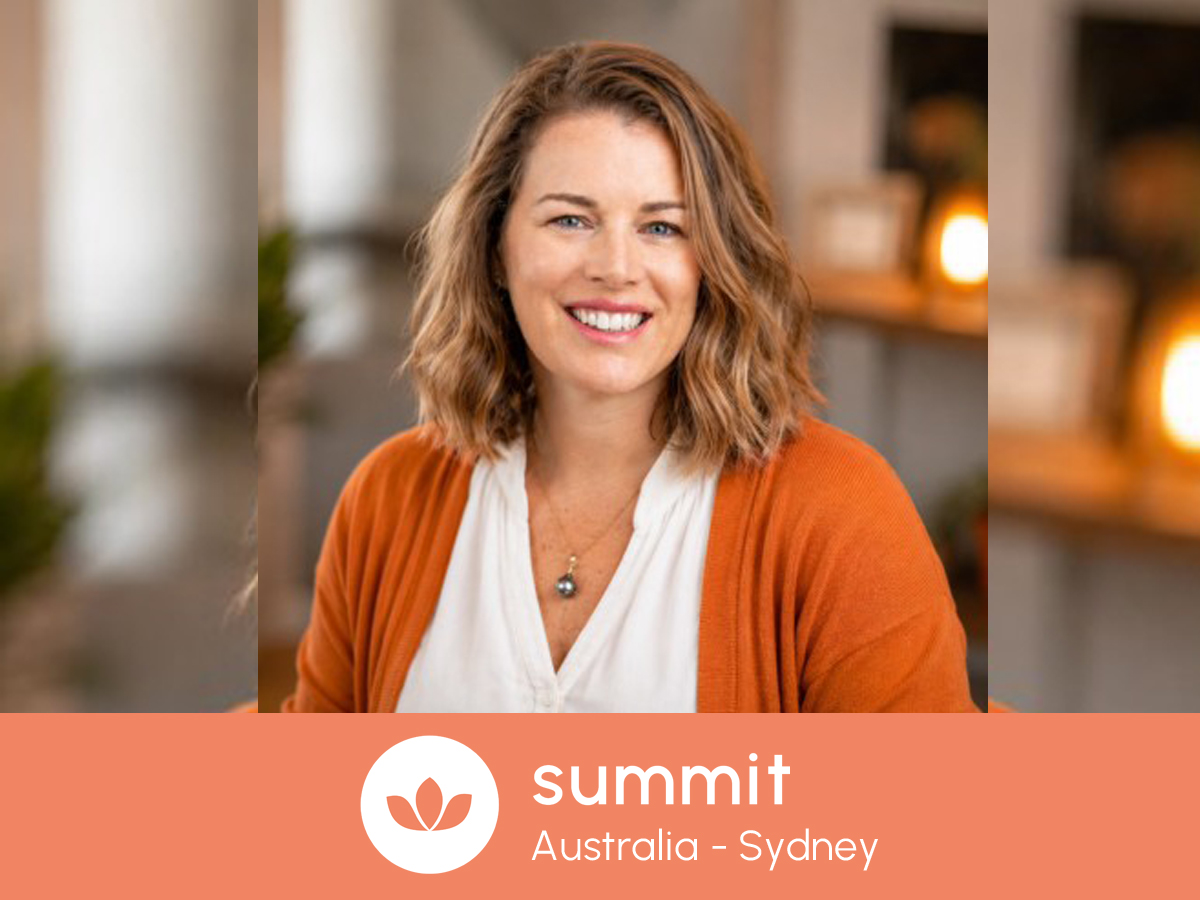
Melanie is a Learning and leadership specialist at Lucid with 20+ years’ experience in innovation, organisational development, human-centred design and nature-inspired design.
Melanie will be hosting our afternoon Leadership Panel at the Wellbeing at Work Summit in Sydney: “The Purpose Effect – Meaning, Energy and Wellbeing at Work”. What happens when people feel deeply connected to the purpose of their work? This panel explores the powerful link between meaning, wellbeing and high performance across very different settings: aged care, engineering, education, architecture, and sport. Together, the panel will unpack how purpose can energise people, build resilience, strengthen connection and inspire better outcomes.
We caught up with her to find out how she’s feeling in the runup to the summit:
Hi Melanie, we are thrilled that you are joining us at the Wellbeing at Work Summit Australia in Sydney next week. Our first and most important question is, how are you doing today?
I’m great today because I’m about to reconnect with nature. This has become a source of wellbeing and purpose for me. I am a professional biomimicry practitioner, so I study how nature solves problems and explore how we can translate those lessons into the way we work, design and lead. I find learning intrinsically rewarding, so being curious about something I care deeply about gives me energy.
As a leader based in the region, what are the main challenges you are facing when it comes to employee wellbeing and mental health?
Our organisation is enjoying a period of strong growth, which brings opportunity but also new demands, particularly for leaders. One challenge is finding the capacity to redesign how we work for the organisation we are becoming rather than simply working harder within the organisation we were. Growth also creates ambiguity. Roles, structures and ways of working evolve before we have all the answers. So an important wellbeing question for us is: how do we help people retain a sense of agency, capability, purpose and connection while navigating uncertainty?
What strategies have you seen developing over the past 6 months, both internally and externally, that are moving the dial on wellbeing in the workplace?
Internally, we’re increasingly using collaborative co-design as we mature our systems and ways of working. We know that having agency over your environment can contribute to motivation and wellbeing. Our leadership development is also helping people become more comfortable with ambiguity. Language such as progress over perfection creates permission to experiment and learn. Externally, I’m interested in the shift from wellbeing as a collection of interventions towards the design of work itself. This includes purpose, autonomy, learning, connection, workload and recovery.
Why is employee wellbeing so important to you personally?
My journey into biomimicry has changed how I think about wellbeing. It has led me to study outside work, travel, research, create, experiment and contribute well beyond what anyone has asked me to do. That effort has benefitted my work and workplace while energising me. This shows me that purpose can change our relationship with effort. But nature has also taught me an important counterpoint in that no healthy living system grows continuously. There are cycles of activity and recovery, growth and consolidation, expansion and renewal. So, I’m interested in sustainable wellbeing achieved through balance.
What impact is AI having in your organization and how are you managing that?
AI is a powerful capability tool. It can accelerate reading, analysis, calculations, drafting and ideation. But what happens when we remove the easy work? So, historically, our working days moved between cognitively demanding work and relatively routine tasks. AI can compress many of those routine activities from hours into seconds, potentially leaving us to move from one complex cognitive task directly to another. We are managing this by investing in expansive thinking to build cross-unit collaboration and uplift innovation capability. A place where AI may be considered but is not able to replace the creativity this fosters.
Other than AI, are there any challenges that you are seeing for the first time and how are you addressing them?
One significant challenge is the cumulative pace of change. Technology is changing how work is performed, cyber threats continue to evolve, organisations are growing and restructuring, and people are continually being asked to adapt. We create environments in which people remain curious and capable of learning, being comfortable with ambiguity and not knowing all the answers. That is where I see an important intersection between learning and wellbeing. If change makes us feel incapable and powerless, it can be threatening. If we have the skills, support and agency to explore it, that same uncertainty can become an opportunity for growth.
What areas do you think employers should be focused on over the next 12 months?
I would encourage employers to broaden the definition of wellness to be reducing risk as well as finding out what makes people come alive. What are they curious about? Where do they experience mastery? What feels meaningful? We can create conditions in which people can discover meaning and connect their contribution to something they value. Meanwhile, leaders need to model balance through renewal.
Do you feel that investment in employee wellbeing in the region is increasing or decreasing and is that a direct reflection on HR leaders’ increasing ability to demonstrate effective returns of their strategies to leadership?
I think an interesting change is in what we define as wellbeing investment. Historically, wellbeing has been siloed within a collection of wellbeing programs and benefits. Increasingly, it is becoming connected to leadership, work design, psychosocial safety, learning and organisational performance. I am also seeing an increasing interest in assessment and evaluation of wellbeing support, particularly beyond participation alone.
How has your organisation been leading the way?
One thing I’m particularly proud of is our approach to co-designing wellbeing resources with our people. One example emerging from this approach is language. Rather than organising resources around diagnostic labels such as “managing anxiety”, we have explored the real-life situations people may recognise themselves in such as “balancing study and work”, “becoming a parent”, “bereavement and loss” or “relationships”. More broadly, my work in Learning & Development has convinced me that wellbeing and development belong together. People need opportunities to grow, discover what interests them, become good at things that matter to them and understand how their contribution connects to something bigger.
Melanie will be speaking in Sydney as part of our Wellbeing at Work Summit Australia which take place this November in Sydney, Melbourne and Brisbane. Click the links below to find out more and book your tickets:
To find out more about our Sydney summit and book your tickets click here.
To find out more about our Melbourne summit and book your tickets click here.
To find out more about our Brisbane summit and book your tickets click here.