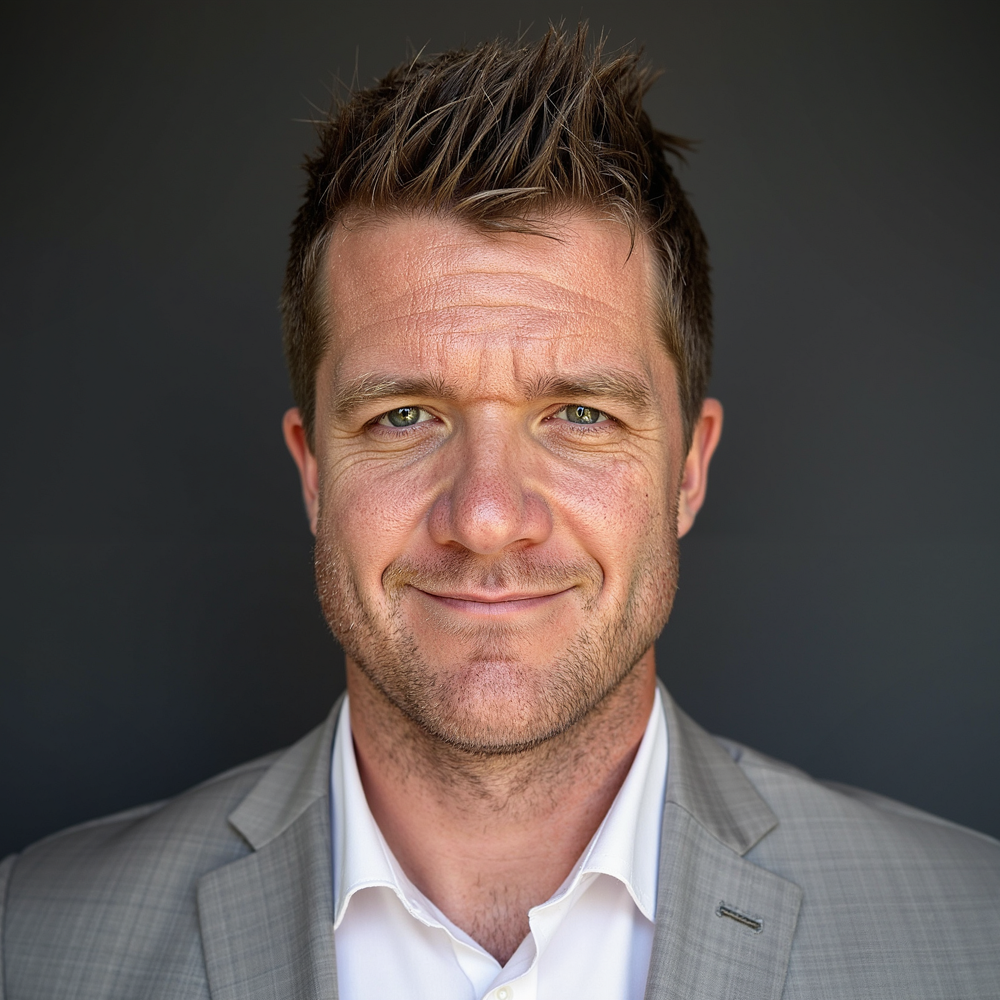
Every wellbeing survey is designed for an “average employee” who doesn’t exist — neurodivergent employees are the most visible proof, but no one in your workforce matches the average profile. We are excited to share that Hans will be presenting at our Amsterdam summit later this month and will be exploring “Why Wellbeing Programs Fail When They Measure for Averages — and What to Do Instead”
We caught up with him to see how he’s feeling in the run up to the summit:
Hi Hans we are thrilled that you are joining us at the Wellbeing at Work Summit in Amsterdam later this month. Our first and most important question is, how are you doing today?
Such a nice question! Really well, thank you. Life is genuinely full right now — two young children at home, a lot of travel, running a research lab while building a company at the same time. That sounds like a lot when I say it out loud, and it is, but I find it energising in a way that I think only happens when the work means something to you. And I’m based in the Alps, which helps keep everything in proportion. It’s hard to catastrophize when you can see the mountains from your window.
As a leader based in the region, what are the main challenges you are facing when it comes to employee wellbeing and mental health?
The one I keep returning to is that we keep designing for a person who doesn’t exist. One of the few laws in all of psychology — if there’s anything approaching a law in our field — is that people are fundamentally unique. Not just different on average across groups, but genuinely singular in how they experience stress, connection, meaning, and struggle. That’s not a philosophical position, it’s empirical. And yet almost everything we build in workplace wellbeing is built around averages — the aggregate survey score, the composite wellbeing index, the population-level benchmark. These tools describe a statistical fiction and then ask managers to intervene on it. The gap is particularly stark when it comes to loneliness and social disconnection, which is where our early work is focused. Two people can have identical scores on every instrument you care to use, and one is quietly thriving while the other is in a serious and worsening state of isolation. You can’t see that in the average. You can only see it if you start from the individual.
What strategies have you seen developing over the past 6 months, both internally and externally, that are moving the dial on wellbeing in the workplace?
There’s a lot of understandable anxiety about AI in the workplace right now, and I don’t think it deserves to be dismissed. We genuinely don’t know yet what it means for how people work, connect, and find meaning in what they do — and that uncertainty is real. But there’s one specific thing AI offers that I think changes the fundamental constraints of this field: it makes personalization scalable for the first time. We have known for decades that idiographic approaches — built around the individual rather than the group average — consistently outperform nomothetic ones. The science has always pointed in that direction. The obstacle was never the evidence, it was scale. You simply couldn’t do it across a workforce of thousands with the tools that existed. That constraint is now lifting. The organizations I see genuinely moving the dial are the ones who’ve understood that the same technology generating legitimate anxiety about the future of work is also, for the first time, making it possible to understand their people as individuals rather than data points.
Why is employee wellbeing so important to you personally?
Partly personal history. I’ve worked in environments where the dynamics were genuinely damaging — toxic incentive structures, poor leadership, people quietly deteriorating over months while the organisation had more than enough capacity to do things differently. What I kept coming back to wasn’t the dysfunction itself but how preventable it was. The resources existed. The understanding didn’t. With better tools, better insight into what people needed, most of that wouldn’t have happened the way it did. That stayed with me. I’ve spent fifteen years building the science of loneliness and social connection, and the further I went, the more I kept arriving at the same conclusion: we know enough to do this right. We have known for a long time. What’s been missing is the infrastructure to act on that knowledge inside real organizations at real scale. Building that infrastructure is what I’m trying to do now.
What impact is AI having in your organization and how are you managing that?
Two quite different answers, really. The first is operational. We use AI agents actively across our day-to-day work — not to replace judgment, but to protect it. The volume involved in building a science-led company is relentless, and AI creates space for the thinking that actually matters. It absorbs what’s routine so we can stay present for what isn’t.
The second is our product, and that’s where I think AI does something genuinely transformative. We combine large language models with validated psychometric science to produce personalized assessments of how individuals understand and report their own experience of loneliness and social connection. I want to be precise about that, because organizations have legitimate concerns about where AI is heading in this space. The EU AI Act is right to restrict systems that infer emotions from behavioral signals — from tone, facial expression, passive monitoring. That approach is both scientifically weak and ethically problematic. What we do is built entirely on what people choose to share, structured through validated psychometric instruments. What AI then unlocks is the ability to do that rigorously and personally at scale — enabling real care matching, early warning capacity, and giving individuals a far richer understanding of their own social needs than any blunt instrument has previously allowed.
Other than AI, are there any challenges that you are seeing for the first time and how are you addressing them?
The one I find most underappreciated is the quiet erosion of what I’d call the informal social architecture of work. For most of the history of modern organizations, culture wasn’t something that got consciously designed — it accumulated through proximity. Through the unplanned conversations, the weak ties built over years of small repeated contact, the sense of belonging that doesn’t come from structured activities but from simply being around people regularly over time. Hybrid work disrupted that accumulation, and what concerns me is that the disruption is largely invisible to the organizations experiencing it. People who’ve joined in the last few years often have no reference point for what that infrastructure felt like when it was working — so they don’t know what’s absent, they just feel its absence. And because it doesn’t surface cleanly in any metric, it tends to get misread. Treated as a motivation problem, a management problem, a fit problem — and addressed accordingly, which means it doesn’t really get addressed at all.
But here’s the thing — and this is where personalization becomes essential rather than just desirable. For me personally, hybrid work has been a genuine blessing. I have two young children, I’m based in the Alps, and the flexibility has made a kind of life possible that simply wouldn’t have been otherwise. I suspect that’s true for a lot of people. The mistake is treating hybrid work as uniformly good or uniformly damaging, when the reality is that it lands completely differently depending on who you are, what stage of life you’re in, and what your social needs actually are. Some people lose their primary source of human connection when they stop going into an office every day. Others finally get to build one outside of it. You cannot design a meaningful response to that without first understanding the individual. That’s what most organizations are still missing — and it’s exactly the gap we built Entrelacs to close.
What areas do you think employers should be focused on over the next 12 months?
The most important shift is from generic to genuinely personal. Not personalized in the superficial sense of customised app experiences or tailored benefit menus, but actually understanding what each specific person in your organisation needs to feel connected, to do work that matters to them, and to sustain that over time. The tools to do this now exist in a way they didn’t even five years ago. The science underpinning it has existed for much longer. What’s been missing is the infrastructure connecting the two, and that gap is closing faster than most organizations realise.
Alongside that: build early warning capacity now, before you need it. The organizations that will lead on social health over the next decade are the ones investing in predictive infrastructure today — not waiting for a wave of resignations or a clinical crisis to discover that a significant part of their workforce has been struggling for months. And stop treating social connection as a culture calendar initiative. Connection is a function of how work is actually designed — job architecture, team structure, the conditions under which people interact. If it isn’t built into the structure, no amount of social programming will compensate for its absence.
Do you feel that investment in employee wellbeing in the region is increasing or decreasing and is that a direct reflection on HR leaders’ increasing ability to demonstrate effective returns of their strategies to leadership?
I want to be honest that I don’t have a comprehensive view here. My perspective is specific — shaped by the organizations I work with directly, the policy conversations I’m part of, and the European research ecosystem around social health. From that vantage point, what I observe is less a clear directional trend in investment levels and more a meaningful shift in the quality of the conversation. There is more seriousness around measurement, more genuine demand for evidence of impact, and more willingness to treat social health as a legitimate occupational domain rather than a discretionary extra. Whether that translates into sustained budget increases across the board, I genuinely can’t say. What I do believe is that where the evidence is presented rigorously and the business case is made clearly, investment tends to follow — and HR leaders are becoming considerably more sophisticated at both. That matters more in the long run than headline budget numbers.
How has your organisation been leading the way?
For the first time, we have built the diagnostic infrastructure that makes it possible to understand social health at work with genuine scientific rigor — personalized, at scale, and actionable. That has never existed before. Organizations have had engagement scores and culture surveys, but those tools describe a population average, not a person. What Entrelacs produces is a real profile of how an individual experiences connection and loneliness — built from what they’ve chosen to share, structured through decades of validated psychometric science, and made personal through AI in a way that simply wasn’t possible until now. For organizations, that translates into something they’ve rarely had: early warning capacity, real insight into where their culture is working and where it isn’t, and the evidence base to act before problems become crises. We think of ourselves as the diagnostic layer that turns good intentions around workplace wellbeing into something organizations can actually stand behind. The intentions have always been there. The infrastructure hasn’t. That’s what we’re building.
Hans is speaking in Amsterdam as part of our Wellbeing at Work Summit Europe 2026 which takes place in Zurich, Amsterdam and Madrid later this month. Click the links below to find out more and book your tickets: